
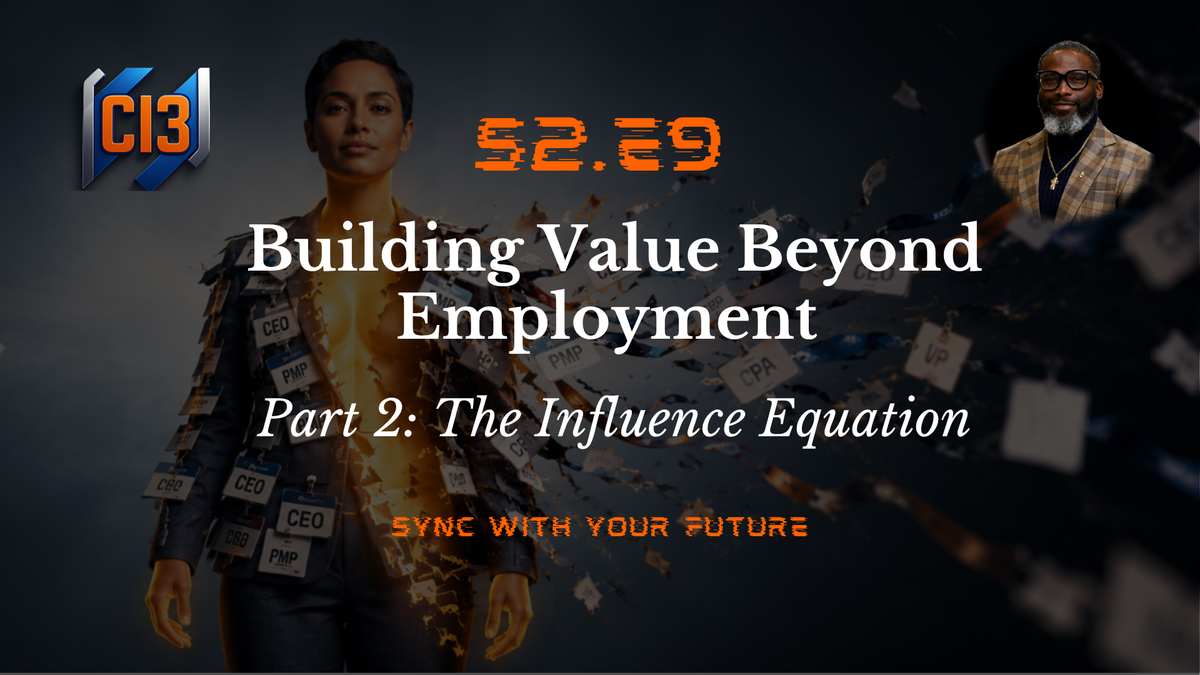
"What separates the person who is excellent at delivering what they were asked to do from the person executives trust to tell them what should be done in the first place?"
Welcome to Part 2 of our four-part series on S2.E9 of the CI3 Fireside Chat: Building Value Beyond Employment with Amy Timmins, Nofal Abdulhadi and Atif Rashid. In Part 1, we exposed the dangers of the "Title Trap" and the necessity of building professional capital outside your organization. Today, we turn inward to examine how you wield value inside the room. The corporate world is overflowing with brilliant delivery specialists who are stuck in mid-management because they mistake execution for strategic influence. This part is dedicated to bridging that gap. We will explore how to transition from a pure tactician to a trusted advisor by mastering empathy, refining your judgment, and learning when to slow down.
Opening Moment: The Empathy Audit
During the session, Amy Timmins shared a vulnerable story about seeking feedback through a 360-degree assessment. The results were a harsh reality check: she was told her empathy was superficial. She would listen to colleagues' concerns, say "thank you for your feedback," and then completely fail to close the loop or explain why their ideas were not implemented. To fix this, she hired a coach to help her build "intrinsic empathy", the ability to genuinely hear people and incorporate their risks into her strategic planning. That shift did not just make her a better colleague; it transformed her into an executive powerhouse who could command influence without formal authority.
1. The Delivery Specialist Trap
Many professionals build their entire brand around being the person who simply "gets things done". While execution is absolutely critical for any organization, being an exceptional delivery specialist can actually box you into a corner. If you only ever execute the strategies handed down to you without connecting your work to the broader business outcomes, you train executive leadership to view you as a reliable tool rather than a strategic partner.
To break out of this trap, you must learn to question the strategy without challenging the strategist. Amy highlighted the importance of being "curious without judgment". Instead of bluntly attacking a flawed plan, a trusted advisor facilitates the conversation by asking neutral, outcome-driven questions that gently guide the leader to see their own blind spots.
"I used to say when I was early in my career, I get stuff done and I get it done. And since then, I've really changed that to be like, I get stuff done in the right way at the right time for the right outcomes." - Amy Timmins
Insights 🔎:
- Execution alone is insufficient for executive progression; you must explicitly connect your daily output to the organization's macro outcomes (e.g., market share, margins, productivity).
- Directly attacking a leader's strategy triggers defensiveness, while neutral, curious questioning fosters a collaborative advisory relationship.
- You must cultivate a deep internal network to verify if a beautifully designed executive strategy is actually achievable on the ground floor.
Actions 🛠️:
- Review your current primary project and explicitly map its deliverables to two high-level strategic outcomes your CEO or department head cares about.
- Practice the "curious pivot": next time you spot a flaw in a plan, frame your concern as a neutral question (e.g., "Are we thinking about X, or is that off the table for now?").
Quick Win ✅:
- Rewrite your professional summary today to remove the phrase "getting things done" and replace it with language highlighting your ability to drive strategic business outcomes.
2. The Intimidating Expert
When you possess deep technical competence, it is incredibly easy to accidentally weaponize your knowledge. I confessed to the panel that my wife once pointed out I had a "chip on my shoulder". What I internally categorized as self-worth and confidence was actually projecting outward as an intimidating, unapproachable arrogance that burned bridges.
Creating value beyond your title requires the emotional intelligence to lower your shoulders and present your expertise as a supportive recommendation rather than a heavy-handed mandate. If you constantly try to prove that you know more than your boss, you will alienate the exact people whose sponsorship you need. True value is demonstrating that you can solve a problem before it surfaces, in a way that empowers the leader rather than threatening them.
"Charles, you've got a chip on your shoulder. I realized that chip on my shoulder, which I tag as myself worth, could be quite intimidating if I do not know how to bring your shoulders down." - Dr. Charles Igwe
Insights 🔎:
- Unregulated confidence and technical brilliance can easily be misperceived as arrogance, severely limiting your ability to build necessary political alliances.
- Providing solutions is only half the battle; the delivery mechanism must be non-intrusive and non-threatening to executive egos.
- True professional maturity is the transition from desperately wanting to "be known" for your intelligence to simply wanting to "know" your field deeply.
Actions 🛠️:
- Ask a trusted colleague to honestly evaluate your tone in cross-functional meetings to identify if you are unintentionally coming across as combative or dismissive.
- When presenting a solution to a senior leader this week, frame it as an "option for consideration" rather than the "only correct path."
Quick Win ✅:
- In your next email outlining a recommendation, remove any absolute language ("we must," "I know") and replace it with collaborative phrasing ("we might consider," "the data suggests").
3. Judgment Over Data
As you ascend in your career, the problems you face become less technical and more nuanced. Nofal Abdulhadi provided a masterclass on this transition from the chat. He noted that his background is in complex infrastructure and energy projects, where every decision has massive commercial consequences.
He shared a story about a critical project delay where the technical data clearly indicated they should accelerate aggressively. However, the technically strongest answer is rarely the strategically correct one. As a leader, Nofal had to look beyond the spreadsheet and factor in human capacity, safety risks, and stakeholder confidence. He chose a controlled recovery plan because leadership judgment demands that you connect the raw data to the human reality.
"I once faced a project delay where the technical answer was to accelerate aggressively. But that would have increased safety, quality, and commercial risks, so we chose a more controlled recovery plan... expertise tells you what is possible, while leadership judgment helps you decide what is right." - Nofal Abdulhadi
Insights 🔎:
- The mathematically or technically perfect solution will often fail if it ignores organizational capacity, safety, and reputational risk.
- Technical expertise only illustrates what is theoretically possible; executive judgment is required to determine what is actually sustainable.
- Leaders who rely exclusively on data without measuring human and commercial variables ultimately invite catastrophic operational failures.
Actions 🛠️:
- Before finalizing a major technical decision this week, deliberately list three non-technical, human-centric risks (e.g., team burnout, stakeholder panic) that the data does not capture.
- Schedule a brief check-in with your frontline execution team to verify if a proposed "aggressive acceleration" is actually feasible without compromising quality.
Quick Win ✅:
- Add a "Human/Organizational Impact" section to your next standard project status report, elevating the conversation beyond pure metrics.
4. The Power of Slowing Down
In a corporate culture obsessed with speed, efficiency, and meeting deadlines, slowing down is often viewed as a weakness. Atif Rashid profoundly challenged this mindset. As an amputee, Atif relies on a prosthetic leg, which forces him to walk at a slower pace than his peers.
Instead of viewing this as a deficit, he transformed it into a core tenet of his leadership philosophy. He uses his natural pacing as a literal and metaphorical tool to stop executives in their tracks when they become mindless goal chasers. By deliberately slowing the tempo in the office, he forces his teams to stop obsessing purely over deadlines and start appreciating the humanness of their work and the relationships they are building.
"My ability, which is I walk slowly, so allows me to be able to slow down more often than not... This Atif, he helps us slow down and appreciate the team that we have created and also bring more of ourselves in the work." - Atif Rashid
Insights 🔎:
- The relentless pursuit of targets and metrics often strips the humanity and authentic connection out of high-performing teams.
- Slowing down is not a lack of productivity; it is a deliberate strategic pause to ensure alignment, empathy, and team cohesion.
- You can reframe a perceived physical or professional limitation into a unique, grounding leadership superpower.
Actions 🛠️:
- Dedicate the first five minutes of your next team meeting entirely to checking in on your team's mental bandwidth before discussing a single metric or deadline.
- Identify one process in your daily workflow that you are rushing through mindlessly, and intentionally slow it down to evaluate its actual strategic value.
Quick Win ✅:
- Step away from your desk for a 10-minute walk today without your phone, using the time strictly to decompress rather than strategize.
Closing Note
Execution gets you hired; empathy, judgment, and influence get you promoted. When you strip away your formal title, your true value is measured by how safely leaders trust you with their vulnerabilities, how wisely you balance data with human reality, and how effectively you guide your team through the chaos. Stop trying to prove you are the smartest technician in the room, and start proving you are the most trusted advisor.
👇 Are you secretly un-promotable in your current role? Don't wait for your next performance review to find out you've been boxed into a tactical corner. Run your professional strategy through the Competence Trap Wheel to expose your executive blind spots: https://competencetrapwheel.ci3pro.ca/
Next up in Part 3: We will dive into the brutal realities of defining your legacy, how to manage the friction of outgrowing your old identity, and why resilience is often heavily romanticized.
#CareerDevelopment #LeadershipIdentity #ExecutivePresence #CharlesIgwe #FiresideChat #ProfessionalValue