
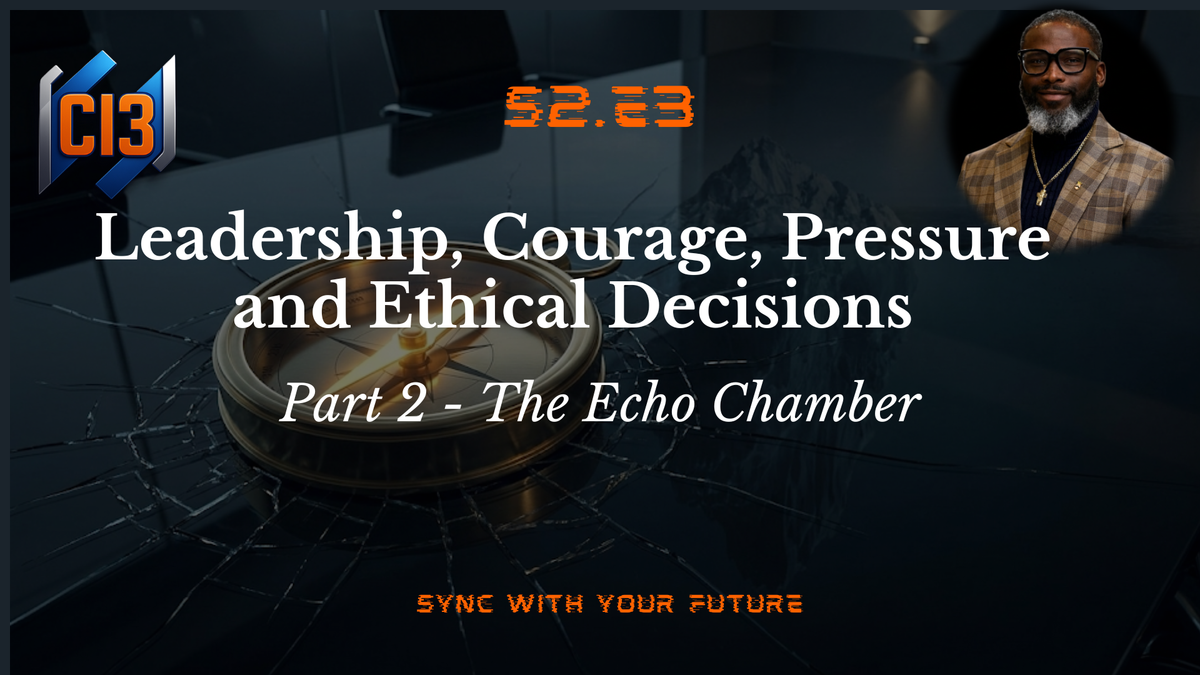
Introduction: The Danger of a Quiet Room
Welcome back to our Fireside Chat newsletter series. Last week, we explored the necessity of prioritizing our values over velocity when forced to make high-stakes decisions in the dark. This week, we confront the most dangerous sound in any executive boardroom: total silence.
Silence is never neutral. It is an active, strategic choice that breeds massive blind spots, and those blind spots eventually mutate into irreversible organizational crises. When the pressure rises, the truth often slows down, replaced by polite nods and "green" dashboards that hide the massive icebergs floating just beneath the surface. Today, we break down why the echo chamber exists and how to shatter it.
Opening Moment: The Illusion of Alignment
During our live session, I asked our panelists to imagine a scenario every leader dreads but rarely admits: an executive steering committee where a program is clearly drifting. The numbers presented look optimistic, but privately, the entire team knows there are underlying risks. Yet, when the CEO asks if everyone is comfortable, no one challenges the narrative.
Why does this happen? Because speaking up requires disrupting the peace, and human beings are neurologically wired to seek safety and avoid conflict. But leadership is not about keeping the peace; it is about surfacing reality. If you are sitting in a room where everyone unanimously agrees with you, you are not leading, you are simply being managed by your team's fear of dissent.
1. The Anatomy of a Small Compromise
"Most leadership failures do not begin with dramatic mistakes. They begin with small compromises: a softened message, a delayed escalation, a decision that feels slightly wrong but seems easier in the moment." - Charles Igwe
Disasters in project delivery rarely happen overnight. They are the direct result of micro-failures in communication and minor ethical concessions. A project manager decides to report a critical risk as "amber" instead of "red" to avoid a difficult conversation. A director omits a crucial data point because it contradicts the CEO's highly publicized, optimistic timeline.
These small compromises relentlessly accumulate. Over time, the executive layer is fed a curated, highly polished version of reality that has absolutely no bearing on the actual health of the initiative. The iceberg effect takes hold: what leadership sees above the surface looks beautiful, while the massive risks hidden below are completely ignored until the collision is unavoidable.
Insights 🔎:
- Catastrophic failures are usually the compounding interest of delayed escalations and softened messages.
- Smoothing over bad news is a form of organizational dishonesty that robs leaders of their ability to course-correct.
- The "iceberg effect" ensures that executives are often the last people to know when a project is truly failing.
Action 🛠️:
- The "Red" Reward: Publicly praise the next team member who brings a critical, timeline-busting risk to the table, demonstrating that bad news is safe to share.
- Status Audit: Review your latest project dashboards and actively hunt for the "watermelons", metrics that appear green on the outside but are bleeding red on the inside.
Quick Win ✅:
- End your next status meeting by asking your team: "What is the one thing we are pretending is fine, but actually isn't?"
2. The Conditioning of Silence
"Silence is a conditioning. We are conditioned to stay quiet because it is more manageable than speaking up. No wonder people self-edit and backspace their own thoughts before bringing them out loud." - Yenga Ndinsil
Silence does not just happen naturally; it is an active behavior that is taught. From our earliest days in the workforce, we learn that challenging authority or disrupting consensus carries a heavy social and professional tax. We learn to read the room, curate our responses, and protect our own livelihoods over the integrity of the project.
As Yenga profoundly highlighted, this conditioning leads to a toxic culture of self-editing. When an employee backspaces a brilliant but dissenting thought because they fear the backlash, the organization loses its most valuable asset: human judgment. Overcoming this requires leaders to aggressively dismantle the fear structures they may have inadvertently built through their own reactions to bad news.
Insights 🔎:
- Silence is an active, learned behavior deployed by teams as a survival mechanism.
- "Self-editing" is a hidden, massive tax on organizational intelligence and innovation.
- If a leader relies purely on their title to command agreement, they shut down the very feedback they need to survive.
Action 🛠️:
- Unmute the Room: Implement a "Devil's Advocate" rotation where one team member is explicitly tasked with finding the flaws in the proposed plan.
- Anonymous Channels: Create an untraceable feedback loop for critical project phases, temporarily removing the social tax of speaking up.
Quick Win ✅:
- Wait a full seven seconds after asking a critical question before jumping in to fill the silence. Let the discomfort draw out the truth.
3. The High Cost of Comfort
"Silence can sometimes be strategic, but if your silence is driven by discomfort, it will eventually become very expensive." - Alberto Osman
There is a stark difference between strategic silence-pausing to gather facts, and fearful silence. When an executive steering committee sits through an overly optimistic presentation while knowing the underlying risks are severe, their silence is entirely driven by the discomfort of confrontation.
Alberto warned that avoiding short-term discomfort guarantees long-term expense. When leaders fail to activate the governance structures designed to challenge assumptions, they tacitly endorse failure. The true role of governance is not just to check administrative boxes; it is to force reality into the conversation when human nature prefers to look away.
Insights 🔎:
- Avoiding the discomfort of a hard conversation is a dereliction of leadership duty.
- Governance should act as the mechanical trigger for surfacing uncomfortable truths.
- The longer a hard truth is suppressed, the more expensive it becomes to fix the resulting damage.
Action 🛠️:
- Decision-Forcing Agendas: Restructure your steering committees so they are purely for making decisions, not passively receiving status updates.
- The Baseline Reality Check: Mandate that every optimistic project projection must be accompanied by its worst-case data counterpart.
Quick Win ✅:
- Identify one uncomfortable conversation you have been avoiding to "keep the peace," and schedule it for tomorrow morning.
4. The Craving for Reality
"We have created an environment where people are afraid to tell us the truth. They tell us whatever is needed to keep things smooth. But if I am the leader, the only way I can deal with a problem is if I have the truth." - Lee Lambert
The great paradox of modern leadership is that executives are starved for truth while sitting in organizations perfectly designed to hide it. As Lee pointed out, leaders desperately need the unvarnished reality of a situation to navigate successfully, yet corporate cultures often punish the very people who bring them that reality.
If you shoot the messenger, you will eventually stop receiving messages. A leader must aggressively cultivate an environment where honesty is not just permitted, but demanded and protected. If your team believes that keeping things smooth is more important than keeping things honest, you are effectively flying a plane without a dashboard.
Insights 🔎:
- Leaders are often the architects of the very echo chambers they despise.
- Prioritizing a "smooth" project over an "honest" project guarantees a catastrophic finish.
- Truth requires psychological cover; employees will only deliver bad news if the leader provides the shield.
Action 🛠️:
- The Messenger Shield: Establish a strict cultural rule that anyone who surfaces a major risk is publicly protected and thanked, regardless of the disruption.
- The Reverse 1-on-1: Dedicate your next round of 1-on-1s entirely to asking: "What am I doing that makes it hard for you to tell me the truth?".
Quick Win ✅:
- Reach out to the most critical, outspoken person on your team and ask for their unfiltered opinion on your current top initiative.
Closing: Shattering the Glass
The echo chamber is the most comfortable place for a leader to sit, but it is the most dangerous place for a business to operate. Breaking the silence requires immense vulnerability and the willingness to sacrifice your own comfort for the sake of the organization's reality.
As we prepare for next week, we have to look at what happens when the truth finally comes out, but it conflicts with the survival of the organization. Next week, in Part 3: The Ethical Breaking Point, we will explore the ultimate tension between loyalty to your company and loyalty to your conscience. It is a showdown every leader faces, and there are no easy answers.