Coming soon
The Competence Trap.
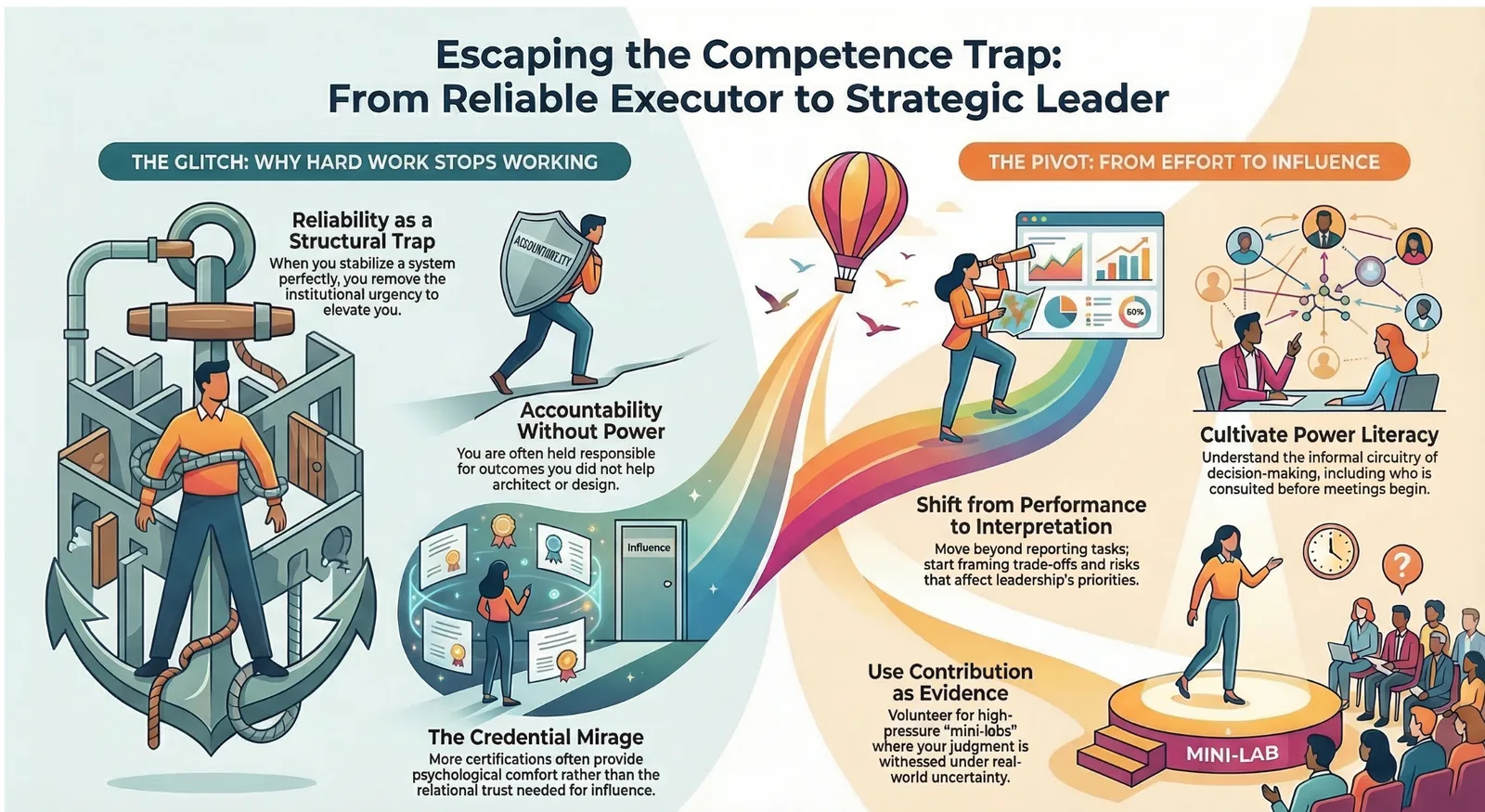
Competence is not the trap. Becoming useful without becoming powerful is.
A book for people whose work has become necessary but whose power has not grown in proportion, trusted with difficult outcomes, relied upon in ambiguity, and praised for carrying what others avoid.
The Trap Index
Ten patterns. Not a label. A diagnostic.
The competence trap rarely announces itself as failure. It often arrives as praise, useful work, respectable opportunities, or responsibility that appears to signal progress. The question is not which pattern fits you perfectly. It's which one helps you read your present situation more accurately. Open a pattern to read the chapter behind it.
The good opportunity that quietly shrinks you.
Is a respectable role moving you toward the work you want to own, or making a smaller identity easier to accept?
Chapter 1
Chapter 01
The Comfortable Lie of Meritocracy
Merit isn't false. It's incomplete, and the day it stops explaining your outcomes, you'll interrogate yourself before you ever interrogate the system.
Merit carries force because it promises dignity without dependence: that you can earn standing cleanly, without needing access, familiarity, or endorsement. When that promise breaks, the instinct is rarely to question the system. It's to ask what credential you're missing, what flaw you failed to detect.
The title as a beautiful cage.
Has an accurate old label become an inaccurate description of your present range?
Chapter 3
Chapter 03
Identity Lag and the Titles That Trail Us
Your language, decisions, and range have moved past the title still being used to explain you, and no one else has noticed yet.
A title can begin as proof and harden into a frame. You can still be admired, still be trusted, and still be quietly compressed by a label your own evolution has already outgrown.
Accountable for the ship, kept away from the wheel.
Where are outcomes attached to your name while decision rights remain elsewhere?
Chapter 2
Chapter 02
Accountability Without Power
You're accountable for outcomes you didn't design. Carry that asymmetry well enough, and it stops looking urgent to anyone but you.
Institutions often separate decision rights from execution capacity: strategy stays concentrated, implementation gets dispersed, and the people closest to consequences absorb the risk for choices made elsewhere. Carry that burden well enough, and your composure becomes the evidence that the arrangement is workable.
The professional who keeps applying instead of solving.
When repeated applications produce little traction, can you lead with the problem you understand and the value you can create?
Chapter 4
Chapter 04
The Credential Mirage
"You have more education than what you are coming to do. You can teach here." One sentence that reveals proof was never the real obstacle.
George Al Haddad arrived in Canada with real engineering experience and registered for another credential, the responsible next step. Then someone told him plainly what changed everything. The obstacle was never proof. It was diagnosis.
The credential collector.
Are you learning what the next move requires, or using another qualification to postpone exposure?
Chapter 4
Chapter 04
The Credential Mirage
"You have more education than what you are coming to do. You can teach here." One sentence that reveals proof was never the real obstacle.
George Al Haddad arrived in Canada with real engineering experience and registered for another credential, the responsible next step. Then someone told him plainly what changed everything. The obstacle was never proof. It was diagnosis.
The ghost with a brilliant résumé.
Can people encounter your judgment, not only your credentials?
Chapters 5 & 6
Chapter 05
The Invisibility Tax
Nearly five hundred résumés. Silence back. Rejection at least tells you that you were seen. Silence doesn't even do that.
Rejection at least acknowledges your arrival. It tells you that you were seen, considered, weighed, and set aside. Silence leaves you arguing with air. Your credentials remain real, your effort remains real, and none of it becomes encounter.
Chapter 06
The Chameleon Frequency
By the time the words leave your mouth, half their force is already spent managing how the room will read you for saying them.
For someone raised to believe worth should emerge through labor rather than announcement, self-promotion doesn't feel unfamiliar. It feels like inverting a moral order that once protected you.
The expert whose data dies in the room.
Can you translate evidence into stakes, choices, and consequence without manipulating the truth?
Chapters 7 & 8
Chapter 07
Visibility and Credibility
Your recommendation gets used. The decision gets better because of you. And somehow, the room still doesn't know it was you.
A contribution can be used repeatedly without teaching the institution where the judgment behind it lives. The recommendation gets absorbed, the analysis helps, the path gets clearer, and the room still doesn't build institutional memory around you.
Chapter 08
Networks as Infrastructure
Real movement happens before the meeting starts. Networks aren't favors you cash in. They're the infrastructure decisions already travel through.
Most advice shrinks networking into favors you collect and cash in later. The real function is different: certain readings of a situation already carry more momentum than others before the first official sentence of a meeting has even landed.
The volunteer who gives value away.
Is your contribution building credible evidence, or teaching the system to expect unbounded labor with no authorship, reciprocity, or exit?
Chapter 9
Chapter 09
Contribution Before Authority
You're waiting for a title to feel safe solving the problem. The organization is waiting to see you solve it before it grants the title.
That's the paradox authority creates for people taught that restraint is respect. We wait for permission to feel safe. The organization is often waiting for proof before it feels safe granting permission.
The truth-teller in a room trained to agree.
What incentives make honesty costly, and how can truth travel upward without losing courage or judgment?
Chapters 2 & 10
Chapter 02
Accountability Without Power
You're accountable for outcomes you didn't design. Carry that asymmetry well enough, and it stops looking urgent to anyone but you.
Institutions often separate decision rights from execution capacity: strategy stays concentrated, implementation gets dispersed, and the people closest to consequences absorb the risk for choices made elsewhere. Carry that burden well enough, and your composure becomes the evidence that the arrangement is workable.
Chapter 10
Leadership in Unfair Systems
What you call persistence, in an unfair system, often looks a lot more like loyal misdiagnosis.
Acceptance sounds like surrender to anyone whose identity was built on the belief that disciplined effort should matter proportionately. Refusing to see the structure as it actually behaves just keeps you arguing with a version of the world that no longer exists.
The leader who decides before certainty arrives.
What decision is waiting for perfect information that will never come?
Chapters 10, 11 & 12
Chapter 10
Leadership in Unfair Systems
What you call persistence, in an unfair system, often looks a lot more like loyal misdiagnosis.
Acceptance sounds like surrender to anyone whose identity was built on the belief that disciplined effort should matter proportionately. Refusing to see the structure as it actually behaves just keeps you arguing with a version of the world that no longer exists.
Chapter 11
The Repositioning Edge
Prudence was supposed to protect your credibility. At some point, it quietly starts defending the cage instead.
The permission reflex feels intelligent, not timid, built from real lessons about timing and credibility. But repeated adaptation eventually acquires the dignity of principle long after the conditions that produced it should have been renegotiated.
Chapter 12
The Work After the Applause
The most dangerous lie success tells you isn't that you made it. It's that you made it alone.
The truth is that the path was always held, briefly, by other people's time, language, access, and willingness to translate your value across a boundary. The work after the applause is deciding whether your visibility will sanitize the old rules or help write better ones.
All twelve chapters, in four parts+
Read from beginning to end, or enter through the pattern above. Four movements, twelve chapters, one collision between merit and system logic.
Part 1 · The Collision
Diagnosing the systemic glitch
01The Comfortable Lie of Meritocracy
Merit isn't false. It's incomplete, and the day it stops explaining your outcomes, you'll interrogate yourself before you ever interrogate the system.
Read more
Merit carries force because it promises dignity without dependence: that you can earn standing cleanly, without needing access, familiarity, or endorsement. When that promise breaks, the instinct is rarely to question the system. It's to ask what credential you're missing, what flaw you failed to detect.
02Accountability Without Power
You're accountable for outcomes you didn't design. Carry that asymmetry well enough, and it stops looking urgent to anyone but you.
Read more
Institutions often separate decision rights from execution capacity: strategy stays concentrated, implementation gets dispersed, and the people closest to consequences absorb the risk for choices made elsewhere. Carry that burden well enough, and your composure becomes the evidence that the arrangement is workable.
03Identity Lag and the Titles That Trail Us
Your language, decisions, and range have moved past the title still being used to explain you, and no one else has noticed yet.
Read more
A title can begin as proof and harden into a frame. You can still be admired, still be trusted, and still be quietly compressed by a label your own evolution has already outgrown.
Part 2 · The Tactical Pivot
The narrative traps we set for ourselves
04The Credential Mirage
"You have more education than what you are coming to do. You can teach here." One sentence that reveals proof was never the real obstacle.
Read more
George Al Haddad arrived in Canada with real engineering experience and registered for another credential, the responsible next step. Then someone told him plainly what changed everything. The obstacle was never proof. It was diagnosis.
05The Invisibility Tax
Nearly five hundred résumés. Silence back. Rejection at least tells you that you were seen. Silence doesn't even do that.
Read more
Rejection at least acknowledges your arrival. It tells you that you were seen, considered, weighed, and set aside. Silence leaves you arguing with air. Your credentials remain real, your effort remains real, and none of it becomes encounter.
06The Chameleon Frequency
By the time the words leave your mouth, half their force is already spent managing how the room will read you for saying them.
Read more
For someone raised to believe worth should emerge through labor rather than announcement, self-promotion doesn't feel unfamiliar. It feels like inverting a moral order that once protected you.
Part 3 · Power Literacy in Complex Systems
Leading through the fog
07Visibility and Credibility
Your recommendation gets used. The decision gets better because of you. And somehow, the room still doesn't know it was you.
Read more
A contribution can be used repeatedly without teaching the institution where the judgment behind it lives. The recommendation gets absorbed, the analysis helps, the path gets clearer, and the room still doesn't build institutional memory around you.
08Networks as Infrastructure
Real movement happens before the meeting starts. Networks aren't favors you cash in. They're the infrastructure decisions already travel through.
Read more
Most advice shrinks networking into favors you collect and cash in later. The real function is different: certain readings of a situation already carry more momentum than others before the first official sentence of a meeting has even landed.
09Contribution Before Authority
You're waiting for a title to feel safe solving the problem. The organization is waiting to see you solve it before it grants the title.
Read more
That's the paradox authority creates for people taught that restraint is respect. We wait for permission to feel safe. The organization is often waiting for proof before it feels safe granting permission.
Part 4 · The Ownership Mindset
Integration and legacy
10Leadership in Unfair Systems
What you call persistence, in an unfair system, often looks a lot more like loyal misdiagnosis.
Read more
Acceptance sounds like surrender to anyone whose identity was built on the belief that disciplined effort should matter proportionately. Refusing to see the structure as it actually behaves just keeps you arguing with a version of the world that no longer exists.
11The Repositioning Edge
Prudence was supposed to protect your credibility. At some point, it quietly starts defending the cage instead.
Read more
The permission reflex feels intelligent, not timid, built from real lessons about timing and credibility. But repeated adaptation eventually acquires the dignity of principle long after the conditions that produced it should have been renegotiated.
12The Work After the Applause
The most dangerous lie success tells you isn't that you made it. It's that you made it alone.
Read more
The truth is that the path was always held, briefly, by other people's time, language, access, and willingness to translate your value across a boundary. The work after the applause is deciding whether your visibility will sanitize the old rules or help write better ones.
From the Author's Note
"If you become a director, who will do the dirty work?"
This book began with a professional sentence I could not forget. The question sounded practical. It was also diagnostic. It revealed how easily an institution can depend on a person's competence while remaining unable, or unwilling, to imagine that competence as authority.
This is not a book against competence, service, humility, credentials, or contribution. It is a book against allowing those strengths to become unexamined instruments of containment.