
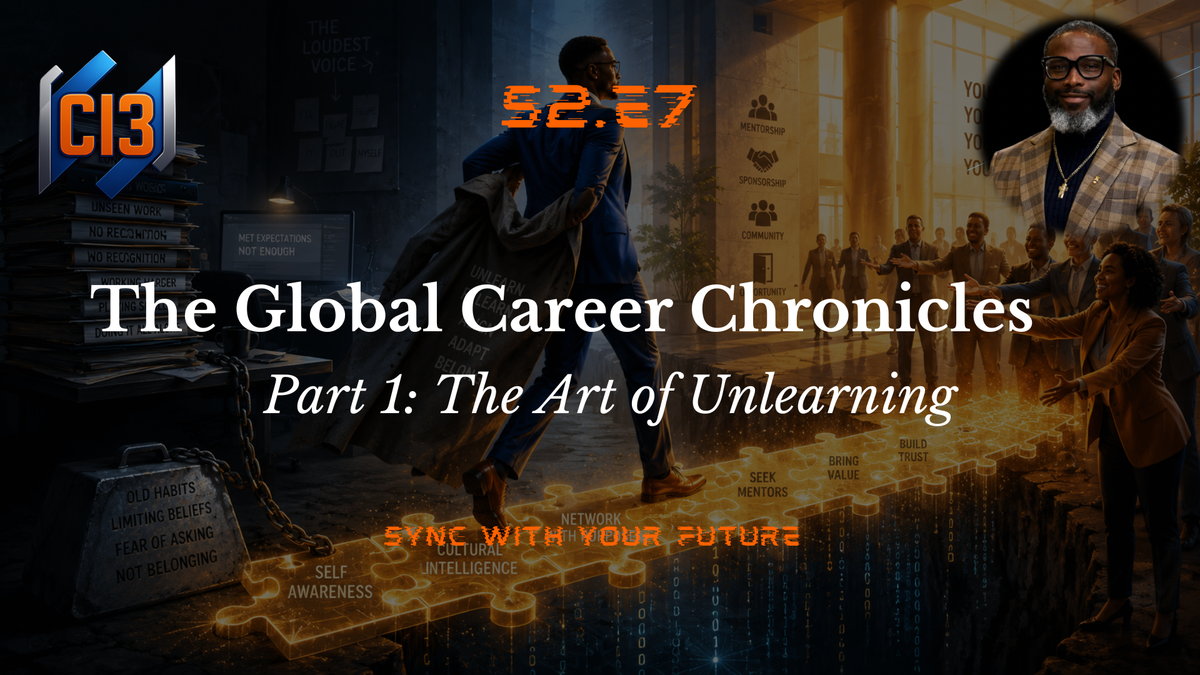
Welcome to Part 1 of our three-part deep dive into S2.E7 of the Fireside Chat: The Global Career with Lavagnon Ika, Latifa Baba and Temisan Sagay.
Many professionals arrive in new countries assuming their raw competence and sheer work ethic will automatically translate into executive success. Today, we confront the reality of career stagnation across borders. The strategies that made you a champion in your home country might actively sabotage your growth globally. To thrive, you must unlearn outdated habits, decode new cultural environments, and strategically position your value.
Opening Moment: The 22-Month Reality Check
During the live session, Temisan shared a raw look into his early days in Canada. Arriving with the assumption that his prior experience would make him highly sought after, he was met with a brutal waiting period. "It took me 22 months to get my first job. Two whole years, almost... I had to take many steps back to get there," he confessed. His story shatters the illusion that credentials alone guarantee a seamless transition. Thriving globally requires facing friction, stepping out of your comfort zone, and having the humility to realize that integration requires a completely new playbook.
1. Working Smart, Not Hard
Immigrant professionals often try to secure their place by taking on overwhelming workloads to prove they belong. We assume that putting our heads down and grinding will automatically be recognized and rewarded by executive leadership. The belief is that sheer volume of output is the undeniable proof of our value.
"That trying to be the smartest in the room, building the credentials... is one thing, but building the right relationships, networking is actually the key to success." - Latifa
Latifa exposed the flaw in this logic during the live session. She recounted working grueling 60- to 70-hour weeks, expecting a top performance rating, only to receive a frustrating reality check when she was told she merely met expectations. She realized that the corporate system does not reward sweat; it rewards working smart, building the right relationships, and establishing strategic trust.
Insights 🔎:
- The corporate system does not inherently reward extra hours; it rewards strategic visibility and the perceived impact of your work.
- Being the smartest person in the room is vastly less effective than networking and building trust with key decision-makers.
- Exhausting yourself on tactical deliverables leaves you with no energy to focus on the high-level positioning that actually drives executive promotion.
Actions 🛠️:
- Audit your weekly tasks and identify one low-visibility deliverable where you are over-delivering. Scale your effort back to the standard requirement.
- Reallocate two hours of "hard work" this week to intentionally building a relationship with a stakeholder outside your immediate team.
Quick Win ✅:
- Decline or delegate one non-essential task today to create a 30-minute strategic networking block on your calendar.
2. The Art of Unlearning
What made you a champion in your home country might cause active friction in a new global setting. We often bring deeply ingrained cultural communication styles, like the need to win every argument, or the assumption that being the loudest voice equals leadership, that simply do not translate well overseas.
"I think really having to face that reality, like you have to really unlearn, unlearn a lot of things. You really have to not be the loudest voice in the room sometimes." - Temisan
Thriving across borders requires the humility to let go of the communication styles that no longer serve you. As highlighted in the session, unlearning is not about erasing your identity; it is about developing the emotional intelligence to adapt your delivery so your actual value is understood by your new peers.
Insights 🔎:
- Unlearning is not about erasing your core identity; it is mastering the skill of emotional and cultural adaptability.
- Staying quiet and observing can often yield more strategic intelligence and trust than needing to speak first.
- You must decode the new environment's communication style to ensure your core message is actually understood by your interlocutor.
Actions 🛠️:
- In your next cross-functional meeting, challenge yourself to be the last person to speak, focusing entirely on active listening.
- Ask a trusted local colleague for brutally honest feedback on how your default communication style lands with the broader team.
Quick Win ✅:
- Identify one conversational habit you brought from your home country that causes tension (e.g., interrupting or speaking loudly), and consciously suppress it for your next three meetings.
3. Skipping Trial and Error
There is a cultural stigma in many regions that asking for help implies incompetence or weakness. As a result, many professionals isolate themselves, attempting to figure out complex career transitions entirely on their own through painful trial and error.
During the audience interaction, Uche shattered this myth. He explained that reaching out to established professionals is the primary catalyst for skipping unnecessary career pain. Mentorship and proactive networking are the ultimate cheat codes for accelerating your trajectory and avoiding the traps that derail others.
"Someone once said that a wise man learns from their own mistakes, but a genius learns from other people. I don't have time to do all of trial and error... I found mentorship very, very valuable." - Uche
Insights 🔎:
- Isolation is a choice; if you look hard enough, someone has already successfully navigated the exact path you are trying to walk.
- Seeking out mentorship is the ultimate cheat code for bypassing years of painful, avoidable mistakes.
- Refusing to ask for help out of pride extends your struggle unnecessarily and delays your integration into the global market.
Actions 🛠️:
- Identify two professionals on LinkedIn who hold the exact role you want to have in three years and study their career trajectories.
- Draft a concise, respectful message asking one of them for a 15-minute virtual coffee chat to discuss a specific aspect of their career transition.
Quick Win ✅:
- Reach out to one colleague today and ask for their advice on a minor challenge you are facing, simply to practice breaking the ice and showing vulnerability.
4. Challenging the Status Quo
Compliance keeps you employed, but disruption is what gets you noticed and promoted. Early-career timidity often prevents immigrant professionals from interrogating the very systems they are hired to improve. We tend to accept the constraints given to us instead of asking the difficult questions that drive real business value.
Ashik reflected on this exact paradox during the session. He noted that organizations deliberately hire diverse global talent to break old paradigms, yet we often default to silent compliance out of a fear of rocking the boat. True executive confidence is demonstrated by respectfully challenging outdated mindsets and optimizing the processes you inherit.
"We have to break old mindsets to solving problems... If I was to start over my career, I would challenge those mindsets, challenge the status quo, and have the confidence to do it." - Ashik
Insights 🔎:
- Organizations hire diverse global talent to break old paradigms, but we often default to silent compliance out of fear of rocking the boat.
- Asking "why" a constraint exists is often more valuable to senior leadership than blindly executing a flawed plan.
- True confidence is demonstrated by respectfully interrogating and optimizing the processes you inherit.
Actions 🛠️:
- Identify one outdated process in your current workflow that everyone complains about but no one fixes.
- Draft a brief, data-backed proposal challenging that process and offering a streamlined alternative to your manager.
Quick Win ✅:
- In your next team meeting, respectfully ask, "Why do we execute this step this way?" simply to spark a dialogue on efficiency and show you are thinking critically.
Closing Note
Career acceleration on a global scale is not a purely academic exercise. It requires the humility to unlearn what no longer serves you, the audacity to ask for guidance when you are lost, and the courage to challenge the status quo. Your credentials got you into the country; your adaptability will get you into the boardroom.
👇 Are you secretly un-promotable in your new environment? Before I officially launch this to my broader newsletter, I am testing out a 2-minute diagnostic tool with my community. Find out if your old habits have turned you into a human bottleneck. Run your current strategy through the Competence Trap Wheel to expose your executive blind spots before your next review: https://competencetrapwheel.ci3pro.ca/
Wacth Part 1 on Youtube:
Next up in Part 2: Decoding the Cultural Software. We will dive into Prof. Lavagnon Ika's brilliant breakdown of navigating systemic discrimination, understanding your cultural blind spots, and finding the internal mentors who can decode the corporate matrix for you.
#CareerAcceleration #GlobalCareer #ImmigrantProfessionals #LeadershipDevelopment #CompetenceTrap #ExecutivePresence