
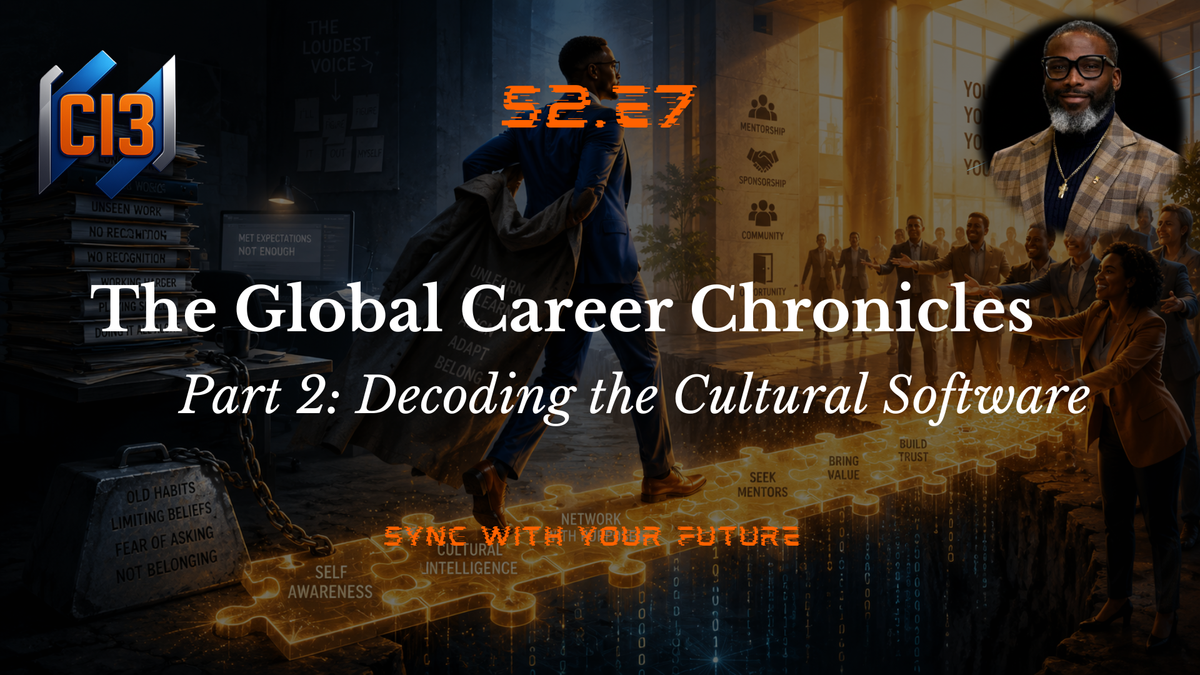
"Your culture is a software, as I say. So if you don't get the software or you can't decode it, then you're missing vital information."
Welcome to Part 2 of our three-part deep dive into S2.E7 of the Fireside Chat: The Global Career with Lavagnon Ika, Latifa Baba and Temisan Sagay.
In Part 1, we established that hard work alone is a trap, and that career acceleration requires unlearning outdated habits. Today, we tackle the invisible forces that govern the global workplace: cultural software and systemic barriers. You can be the most brilliant professional in your organization, but if your operating system is incompatible with the company's culture, your competence will crash.
Opening Moment: The Pain of Being Misunderstood
During the live session, I shared a raw, defining moment from an early stage of my own career. I was unexpectedly removed as the lead in my organization's largest account at the time. "A client said, I don't want Charles on my project, just like that," I recalled. "No reason was given because I smiled a lot". The shock of losing a major client for a reason I couldn't comprehend sent me to the washroom in tears. It was a brutal lesson: sometimes your authentic self actively triggers a cultural barrier, and navigating that reality is mandatory for survival.
1. Controlling the Controllables
Discrimination and systemic barriers exist, and they can derail a global career if you let them consume your focus. Prof Lavagnon shared a vulnerable story about early career discrimination, where colleagues mocked his origins and openly doubted his ability to succeed in his PhD program because he came from Benin Republic.
While he confronted the instigator directly, he emphasized that as individuals, we are often severely limited in our agency against systemic issues. Wasting energy on things completely outside your control diminishes your professional power; survival requires strategic calm and focusing entirely on your own assets and responses.
"My advice, take it cool, calm down, take a deep breath, and then ask yourself, why is it that you are here?" - Prof. Lavagnon
Insights 🔎:
- Systemic barriers are external; wasting energy on things outside your immediate control drains your leverage and emotional capacity.
- Direct confrontation is a tool, but it is limited by power dynamics and must be deployed highly strategically.
- When faced with unfairness, taking a deep breath and reconnecting with your ultimate purpose prevents emotional hijacking.
Actions 🛠️:
- Map out your current workplace frustrations into two columns: "Within My Control" and "Outside My Control."
- Drop all emotional investment in the second column and write an execution plan solely for the items in the first column.
Quick Win ✅:
- The next time you encounter a microaggression or bias, take a deep breath and internally ask yourself, "Why am I here?" before uttering a single word in response.
2. Culture as an Operating System
What you consider your greatest attribute might be interpreted as a threat or liability by another culture. I shared how my passion and loud speaking style were repeatedly miscoded as "anger" or "agitation" by my Canadian colleagues. You can have world-class technical skills, but if you do not decode the room, you will be branded as difficult.
Thriving across borders requires letting go of the rigid expectation that everyone will automatically understand your intent. Latifa emphasized that adapting to a new environment is an act of high emotional intelligence, not a betrayal of your roots. You must learn to translate your message into a frequency the room can actually hear.
"I don't think it's about losing yourself. I don't think it's about changing who you are fundamentally and your values and your background. But it's about the skill of adaptability." - Latifa
Insights 🔎:
- Strengths are highly subjective; their value is entirely dependent on the cultural software of the audience receiving them.
- Behaviors intended to show deep engagement (like speaking loudly or using hand gestures) are frequently miscoded as aggression in Western corporate cultures.
- You cannot force a new environment to learn your software; you must learn to decode theirs to survive and advance.
Actions 🛠️:
- Identify your top three professional strengths and objectively analyze how they might be misinterpreted by someone from a different cultural background.
- Practice "code-switching" your delivery style (e.g., lowering your volume, minimizing hand gestures) to match the ambient energy of a tense boardroom.
Quick Win ✅:
- Ask a trusted peer to discreetly monitor your body language in a meeting today and provide honest feedback on your intensity.
3. The Shift from Expert to Enabler
Early in my career, I assumed that establishing myself as the ultimate authority figure was the fastest way to add value. Like many high-performing delivery specialists, I focused intensely on standards and sharp problem-solving. But experience taught me a profound lesson: extreme competence without perceived approachability creates invisible barriers.
"True executive influence isn't just about showing people what they're missing; it's about giving them the clarity and support to fix it." - Dr. Charles
If people view you strictly as an uncompromising auditor rather than an accessible partner, they hesitate to bring you their rawest, most critical challenges. Modern leadership isn't about being the smartest room in the mirror; it’s about creating the psychological safety that allows others to bring their real problems to light.
Insights 🔎:
- Technical brilliance gets you in the room; approachability and empathy determine how much impact you actually have.
- High-performing leaders must actively balance rigorous delivery standards with a warm, supportive presence.
- Mentees and peers gravitate toward leaders who offer clear, accessible guidance over complex philosophical coaching.
Actions 🛠️:
- Lead with Clarity: When a team member comes to you with a question, offer a direct, encouraging solution before diving into the deeper strategic framework.
- The Accessibility Check: Ensure your open-door policy is backed by an inviting demeanor that encourages early escalation of risks.
Quick Win ✅:
- Next time a colleague asks for help today, give them a crisp, practical answer and thank them for bringing the challenge to you.
4. The Internal Advocate and Decoder
You cannot decode the corporate matrix alone; you need an internal guide who sees your potential and understands the unspoken rules of the environment. Yenga shared a profound story of facing microaggressions early in her career, noting that she initially didn't even realize she was experiencing racism.
It was an internal manager who noted the hostility, pulled her aside, and actively protected and encouraged her. We need internal advocates and mentors who see our greatness when we don't, and who provide the psychological safety required to help us navigate the barriers we are blind to.
Insights 🔎:
- The "cafeteria network" matters: external mentors are great for strategy, but only internal mentors can navigate organizational politics and shadow governance.
- Frank, corrective conversations can only happen when both parties feel psychologically safe and share genuine trust.
- A true mentor is valuable because they prioritize telling you the uncomfortable truth over preserving your ego, protecting your long-term trajectory.
Actions 🛠️:
- Identify one well-respected, culturally fluent leader inside your current company who is not in your direct reporting line.
- Invite them for a coffee chat with the explicit agenda of seeking their guidance on adapting to the company's unwritten culture.
Quick Win ✅:
- Send a message to a senior colleague today asking: "If there is one aspect of the organizational culture I haven't fully grasped yet, what would it be?".
Closing Note
You cannot fight a system you do not understand. Thriving globally requires the humility to acknowledge your blind spots and the wisdom to find a local guide who can decode the matrix for you. If you refuse to adapt your cultural software, your technical competence will never fully execute.
👇 Are you secretly un-promotable in your new environment? Before I officially launch this to my broader newsletter, I am beta-testing a 2-minute diagnostic tool with my community. Find out if your cultural blind spots have turned you into a human bottleneck. Run your current professional strategy through the Competence Trap Wheel to expose your executive gaps before your next review: https://competencetrapwheel.ci3pro.ca/
Next up in Part 3: From Lonely Scholar to Global Authority. We will bring the series to a massive close, exploring how to stop building masterpieces in the dark, the audacity required to fill global gaps, and the truth about translational networking.
#CulturalIntelligence #LeadershipDevelopment #Mentorship #CharlesIgwe #FiresideChat
Watch the Episode on Youtube